
category
- ALL
- Bilingual Doctor
- Breast augmentation
- Deep Plane ミニリフト
- Extended Deep Plane Facelift
- HIFU
- Medical Hair Removal
- Rejuran
- Rhinoplasty
- Uncategorized
- お知らせ
- カウンセリング
- くま治療
- しみ
- スキンボトックス
- たるみ
- ヒアルロン酸
- フェイスリフト
- ボトックス
- ボルニューマ
- メンズ美容医療
- わきボトックス
- わき汗
- 乳輪の色素改善
- 他院修正
- 医療アートメイク
- 医療脱毛
- 学会活動
- 新メニュー
- 毛穴
- 無断キャンセル
- 症例画像
- 眼瞼下垂
- 立体脂肪注入
- 美容
- 美容外科学会(JSAPS)
- 肌メンテ
- 肌育
- 肌質改善
- 肝斑
- 脂肪注入
- 自分らしさを消さない
- 裏ハムラ
- 論文
- 豊胸
- 針脱毛
- 骨切り
The Extended Deep Plane Facelift
監修医師

MSA美容外科 院長モレロ オースティン誠
1989年、アメリカ生まれ。10歳より沖縄で育つ。日本とアメリカ、双方の文化や価値観に触れてきた経験を生かし、患者様一人ひとりが持つ異なる美意識や希望を尊重した診療を大切にしています。日本語・英語の両方で診療を行い、国内外の知見を取り入れながら、自然で長期的な美しさを目指した美容医療を提供しています。大手美容外科にて約8年間、美容外科・美容皮膚科診療に携わり、2024年にMSA美容外科を開院。
略歴
2018〜2024年 大手美容外科沖縄院 院長
2024年 MSA美容外科 開院
資格・所属学会
日本美容外科学会(JSAS)認定専門医
日本美容外科学会(JSAS)正会員
日本美容外科学会(JSAPS)関連会員
The Rhinoplasty Society 海外会員
American Academy of Cosmetic Surgery(AACS)正会員
日本美容皮膚科学会 正会員
日本美容外科医師会 正会員
The Extended Deep Plane Facelift: Advanced Technique for Natural, Long-Lasting Rejuvenation
For women over 40 seeking to refresh their appearance, facelift surgery remains one of the most effective solutions to address sagging skin and deep folds. However, many worry about looking “overdone” or having tight, unnatural results.
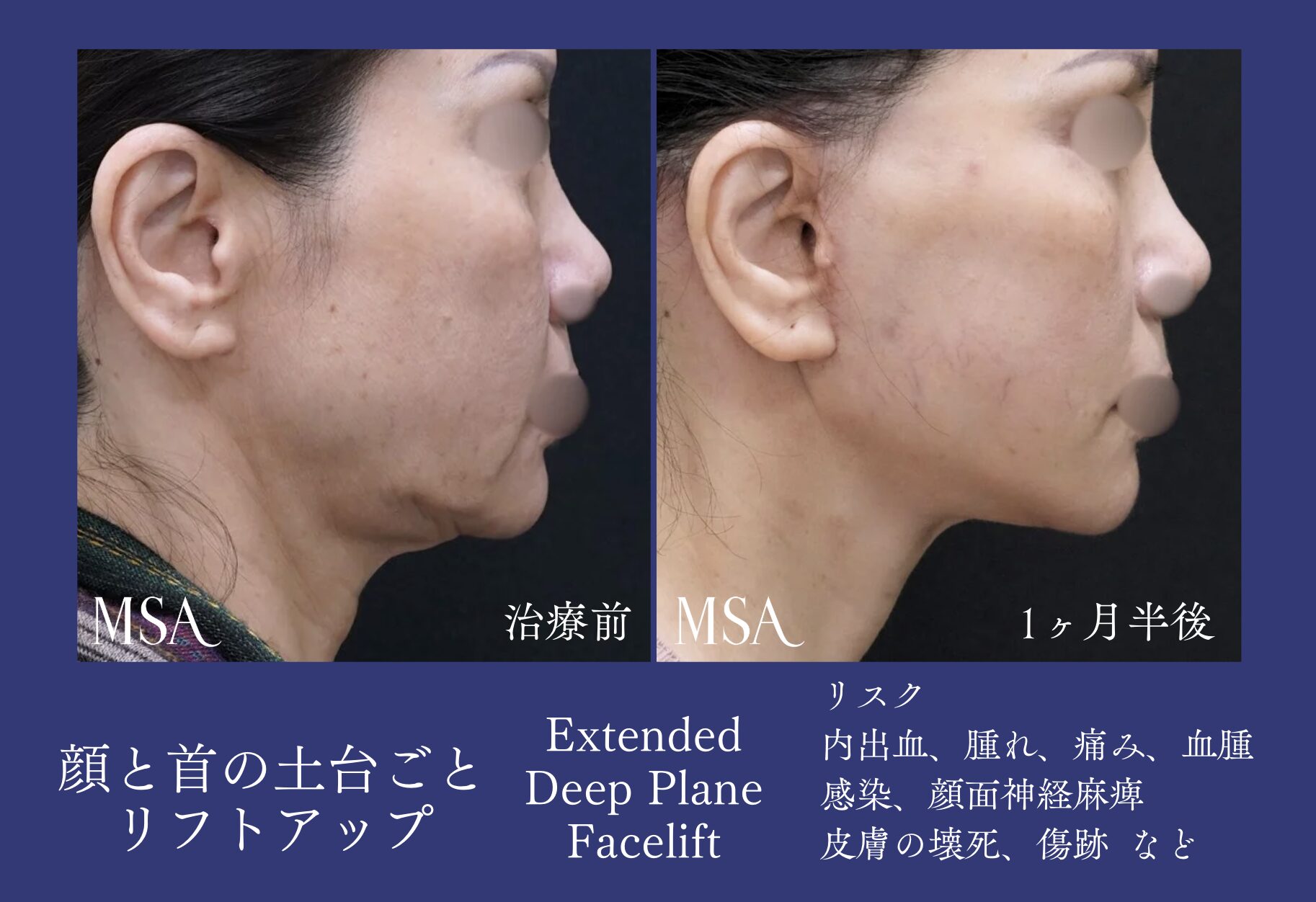
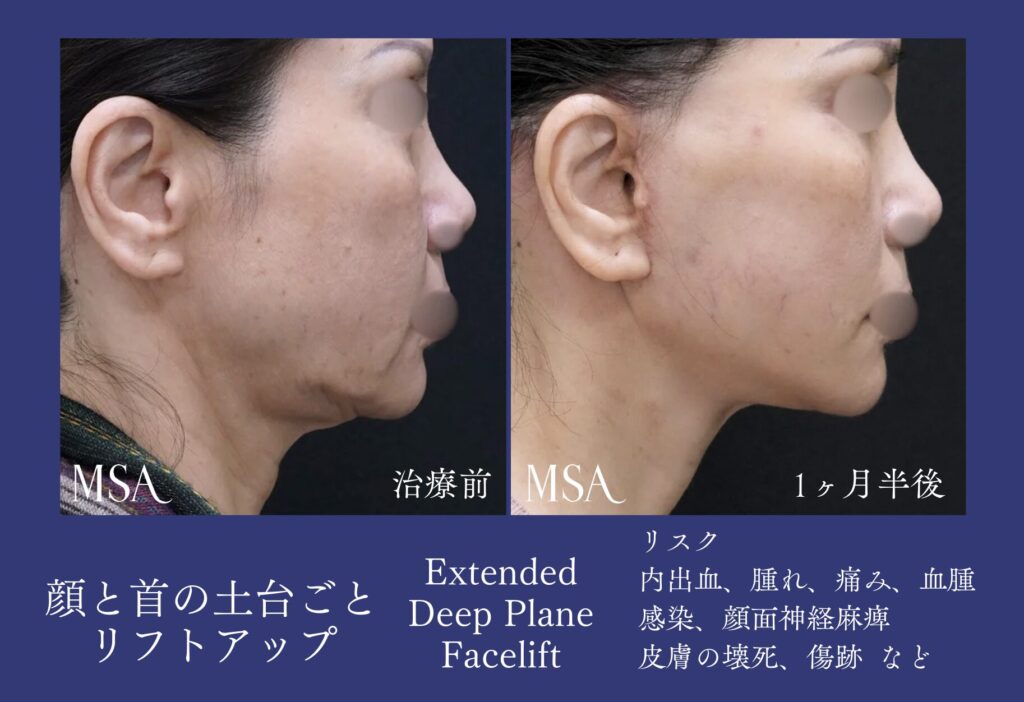
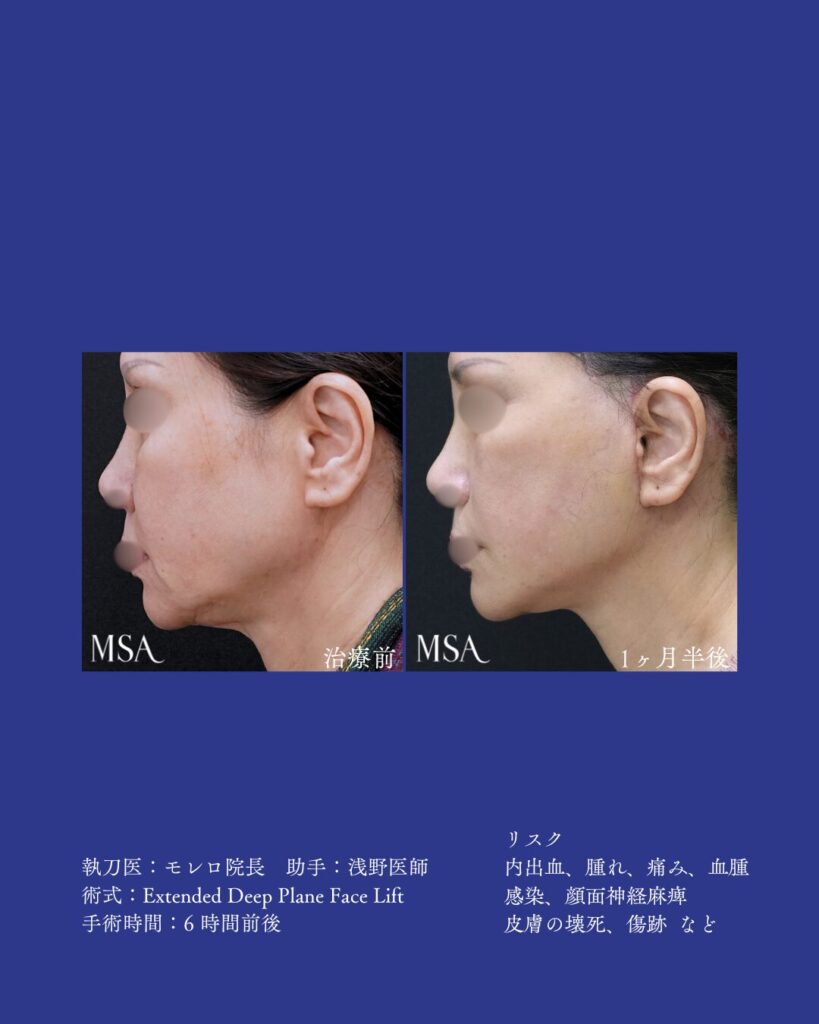
The Extended Deep Plane Facelift is a cutting-edge facelift technique designed to rejuvenate the face and neck with natural-looking, long-lasting outcomes. This procedure goes beyond traditional methods by lifting deeper facial layers as a unit, reducing skin tension and avoiding the windswept look. The result is a youthful yet authentic appearance – a refreshed version of you. Below, we explore what this advanced facelift entails, how it differs from conventional facelifts, who can benefit, and what to expect during the process.
What Is the Extended Deep Plane Facelift?
The Extended Deep Plane Facelift is an advanced form of facelift surgery that targets not just the skin, but the deeper supporting structures of the face. In a standard facelift, a surgeon typically repositions the skin and the superficial muscle layer (known as the SMAS – superficial musculoaponeurotic system) to tighten the jawline and lower face. By contrast, an extended deep plane facelift works underneath the SMAS layer, releasing key attachments in the face and neck to lift the muscles, connective tissue, and fat pads as one continuous unit. This deeper-plane approach allows the surgeon to restore the face’s natural youthful anatomy without relying on excessive skin pulling. In fact, the technique was pioneered as an evolution of the deep plane facelift to further enhance results in the neck area.
During an extended deep plane facelift, the surgeon makes incisions discreetly along the hairline and around the ears (similar to a traditional facelift, so they’re well-hidden). Through these openings, the facial tissues are gently released from certain “retaining ligaments” – firm tether points that normally anchor the skin and deeper tissues to the facial bones. By freeing these points, the surgeon can mobilize sagging cheeks, jowls, and neck tissues more completely. The entire cheek–jaw–neck layer (skin plus underlying muscle/fat) is then repositioned upward to where it was in youth, and secured without putting tension on the skin surface. This means the skin is not being aggressively pulled; instead, the lift comes from re-suspending the deeper structures. The outcome is a smooth, naturally lifted face that respects your unique features – as one surgeon’s philosophy describes it, to “rejuvenate without over-tightening”.
Critically, the “extended” aspect of this technique also involves the neck area. Traditional deep plane facelifts primarily focused on the mid and lower face, but the extended version “extends” the dissection into the side of the neck. By releasing cervical (neck) retaining ligaments and lifting the platysma muscle (the thin muscle layer in the neck), the extended deep plane facelift achieves a true comprehensive face-and-neck rejuvenation. In essence, it’s a combined deep face lift and deep neck lift in one procedure. This comprehensive approach is especially beneficial for patients over 40, since signs of aging often appear in both the lower face and the neck together. The extended deep plane technique addresses both regions harmoniously, creating a youthful jawline and a smoother neck without needing separate surgeries.
How It Differs from Traditional Facelifts
The extended deep plane facelift introduces several important differences – and advantages – compared to a traditional facelift:
- Deeper Lifting for a Natural Look: Instead of pulling the skin taut, the extended deep plane approach repositions the deeper facial layers (muscle and fat) together. Traditional SMAS facelifts tighten the SMAS layer and skin, which can sometimes create a tight or “pulled” appearance if overdone. In contrast, the deep-plane technique releases the facial retaining ligaments and lifts the face from beneath, so the tension is on the tough fascia layer, not on the skin. This yields a tension-free lift with smooth, natural results. Because the face is lifted as a cohesive unit, there’s no stretched look – patients avoid that windswept effect and instead simply look younger and well-rested.
- More Comprehensive Rejuvenation: A conventional facelift usually improves the lower face and jowls, and often requires a separate neck lift or additional procedures for the neck and midface. The extended deep plane facelift, however, treats multiple areas at once. By going under the SMAS and releasing key ligaments, it can lift sagging cheeks, soften deep nasolabial folds (lines from nose to mouth), sharpen the jawline, and tighten a slack neck – all in one procedure. This comprehensive lift leads to a harmonious outcome: your cheeks, jaw, and neck all look rejuvenated together, restoring balanced youthfulness rather than just tightening one area.
- Longer-Lasting Results: Perhaps one of the biggest advantages of the extended deep plane facelift is the longevity of the results. By addressing the root causes of facial sagging – the loosening of ligaments and descent of deep tissues – this technique creates changes that are structurally more stable over time. Traditional facelifts that mainly tighten skin and SMAS might give ~5-10 years of improvement before aging catches up. In contrast, a deep-plane facelift typically maintains results for 10-15 years or more. In fact, surgeons report that extended deep plane patients can enjoy their rejuvenated look for a decade or longer without needing a touch-up. By lifting the inelastic deeper layer (instead of just elastic skin), the face resists drooping again so quickly. For women in their 40s or 50s, this means an extended deep plane lift could carry you well into your 60s with a youthful profile – a worthwhile investment in aging gracefully.
- Improved Neck and Jawline Definition: The extended deep plane facelift specifically targets the jawline and upper neck in a way standard lifts may not. By releasing and lifting the platysma muscle and the retaining ligaments in the neck, it can eliminate jowls and tighten under the chin with precision. Patients often see a sharper, more defined chin–neck angle and a smooth neck contour. Sagging or bulging structures like the submandibular glands (the glands under the jaw), which can create fullness at the neck jaw junction in older individuals, are also supported and tucked up by the lifted platysma in this technique. The result is a sleeker neck and a clean jawline that other facelift methods might not achieve without additional separate neck procedures.
- Restoration of Midface Volume: In aging, not only does skin sag, but the cheeks often lose volume or appear hollow as fat descends. Traditional facelifts primarily reposition skin and SMAS; they don’t directly address lost cheek volume. The extended deep plane technique shines here – by lifting the malar fat pads back up where they belong, it naturally re-volumizes the midface. Remarkably, this approach can restore cheek fullness comparable to adding significant filler, but using your own tissue instead of injections. One published study noted that releasing the zygomatic ligaments and elevating the cheek fat in a deep plane facelift achieved cheek augmentation equivalent to about three syringes of filler, with the improvement being permanent since it’s your native fat repositioned to a youthful spot. For patients, this means fewer ancillary procedures – you may not need that cheek filler or fat graft at all because the facelift itself restores youthful contours.
- Less Skin Tension and Better Scars: Because an extended deep plane facelift lifts from the deeper structures, the skin is not bearing the pull of the lift. The skin is re-draped gently over the lifted tissue, not stretched to achieve the lift. This has two benefits: first, it contributes to the natural look (no tight “plastic” appearance), and second, it leads to improved healing of incisions. With minimal tension on the skin closure, incisions can heal to very fine lines. The scars are typically hidden along the hairline and around the ear curves, and without heavy pull on them, they tend to be thin and inconspicuous once healed. In short, patients often enjoy smoother healing and barely-there scars compared to some older facelift techniques.
In summary, the extended deep plane facelift differentiates itself by treating the face in a more three-dimensional and anatomical way. It doesn’t just tighten the skin; it resets the deeper facial canvas – lifting fallen tissue, restoring volume, and releasing constraints that cause sagging. The outcome is a naturally youthful face that is still you, just 10-15 years younger in appearance, and importantly, it’s an outcome built to last.
Who Is a Good Candidate?
Generally, this advanced technique is ideal for individuals who have significant signs of aging and desire a thorough rejuvenation. You may be a good candidate if:
- You are in your 40s, 50s, or beyond with moderate to advanced facial sagging. Most patients seeking this procedure are in mid-life or older, when skin laxity, jowling, and neck droop have become pronounced. If you notice deep nasolabial folds, marionette lines, jowls blurring your jawline, or a “turkey neck,” a comprehensive lift like the extended deep plane facelift can effectively address these issues.
- Non-surgical treatments are no longer enough for you. Perhaps you’ve tried dermal fillers, skin tightening (lasers or ultrasound), or thread lifts in your 30s or early 40s. These can help early on, but when aging is more advanced, such measures might not give the result you want. If you find that fillers can’t lift your sagging cheeks or that you’re doing more frequent touch-ups without much improvement, it may be time to consider a longer-lasting surgical solution. The extended deep plane facelift is often recommended for those seeking dramatic yet natural improvement when less invasive approaches have reached their limit.
- You desire long-lasting results and are ready for a one-time procedure. Some women prefer to “dip a toe” into anti-aging with minor procedures; others reach a point where they want a definitive, long-term fix instead of frequent maintenance. An extended deep plane facelift is well-suited for the latter – it provides a decade or more of rejuvenation, reducing or eliminating the need for ongoing filler injections, thread lifts, or other repeat interventions. If the idea of a single surgery that sets back the clock for many years appeals to you, this technique could be the answer.
- You seek a natural outcome and are concerned about looking “overdone.” Many candidates are specifically drawn to the extended deep plane technique because of its reputation for subtle, unoperated-looking results. If your biggest fear about facelifts is ending up with a tight, pulled face, this approach is designed to avoid that. It’s a great match for those who want friends to say “You look great – did you change your hair?” rather than “I see you had a facelift.” In other words, you want to look refreshed, not altered.
- You are in good overall health and prepared for a surgical procedure. As with any surgery, good candidates should not have uncontrolled medical conditions. You should be a non-smoker or willing to quit (smoking affects healing), and able to take the necessary recovery time (typically a few weeks off work and strenuous activities). Being in a healthy state maximizes your safety during anesthesia and surgery, and ensures you heal well afterward. Your surgeon will review your medical history to confirm you can undergo the procedure safely.
- You may be considering a secondary facelift (redo) or have challenging anatomy. The extended deep plane facelift can be a great option for those who had a previous facelift years ago and now see sagging returning. Because it works in untouched tissue planes, it can be safely performed as a revision facelift by a skilled surgeon to rejuvenate the face again, often with excellent results even if scar tissue is present from an older technique. Additionally, patients with tougher aging issues – such as very heavy necks or markedly droopy midfaces – might be steered toward an extended deep plane approach as it provides the most robust lifting power and access to address these problems thoroughly.
In essence, the ideal candidate is someone who wants comprehensive yet natural rejuvenation and is ready to invest in the gold-standard technique to achieve it. During a personalized consultation, the surgeon will examine factors like your skin quality, bone structure, and specific aging pattern, and then advise if the extended deep plane facelift matches your goals. If it does, you can feel confident that you’re choosing one of the most advanced facelift methods available today.
What to Expect: Procedure and Recovery
Undergoing an extended deep plane facelift may sound complex, but knowing what to expect can help you feel at ease. From preparation through healing, your surgical team will guide you each step of the way.
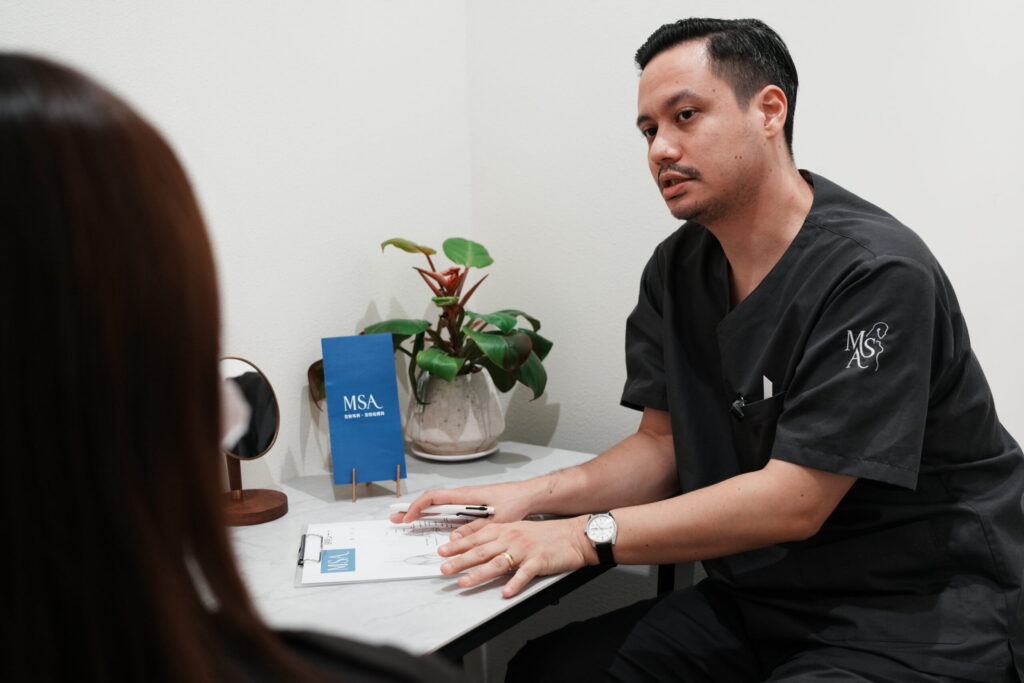
Consultation and Preparation: First, you’ll have an in-depth consultation with your surgeon. They will evaluate your face and neck, discuss your concerns and desired outcomes, and explain how the extended deep plane facelift can be tailored to you. Feel free to ask questions – a good surgeon will ensure you understand the plan and feel comfortable. You’ll receive pre-operative instructions (for example, adjusting certain medications or supplements, and stopping smoking if applicable) to optimize your healing. Because this is an advanced procedure, it’s crucial to choose a board-certified plastic or facial plastic surgeon experienced in deep plane techniques. Their expertise will help maximize results and minimize risks.
The Day of Surgery: The extended deep plane facelift is typically performed in a hospital or accredited surgical center. Most patients are under general anesthesia or deep IV sedation (so you’ll be asleep and feel no pain). The surgery can take several hours, given the meticulous work involved. Your surgeon will make incisions inconspicuously around your ears – usually curving behind the tragus (the little cartilage in front of the ear canal) and around the earlobe, extending into the hairline behind the ear. Through these incisions, the surgeon carefully dissects under the SMAS layer in the “deep plane” of the face. They will release the retaining ligaments that tether your sagging tissues, then lift and reposition the loosened midface, jowl, and neck tissues upward to a youthful position. Any excess skin is trimmed, but remember, the lift is coming from the deeper layers, so only a minimal skin tightening is needed. If you have a lot of neck banding or excess fat under the chin, a small incision under the chin might be made to address those (often, however, the neck is improved sufficiently from the side approach alone due to the extensive release of the platysma in this technique). The incisions are then closed with fine sutures. A soft bandage or wrap may be applied around your face to reduce swelling.
Immediate Post-Surgery: After surgery, you will wake up in a recovery room. Some patients are able to go home the same day (with a friend or family member to drive and assist), while others might stay overnight for observation – your surgeon will decide based on the extent of surgery and your comfort. You’ll have some swelling and bruising on the face and neck; this is normal and expected. There might be a feeling of tightness (more from the swelling than the sutures) and some soreness, but significant pain is not common with facelifts. You will be given pain medication to stay comfortable, though many patients find they only need it for a few days. You’ll also get detailed instructions, such as how to care for incisions, when to wear any compression garment, and how to sleep (typically with your head elevated to minimize swelling). In the first couple of days, it’s important to rest and avoid strenuous activity. Some surgeons place a small drain to prevent fluid build-up; if so, that is usually removed in 1-2 days.
Recovery in the First Two Weeks: The majority of healing happens in the first two weeks. Bruising and swelling will be most pronounced in the first 3-5 days, then gradually subside. By the end of week one, many patients feel much more like themselves. Stitches in front of the ear may be removed around 5-7 days, and those in the scalp (hairline) a bit later, around 10-14 days, depending on the type of sutures used. You’ll likely have follow-up visits during this period so the surgeon can check your incisions and progress. It’s usually recommended to take about two weeks off work and social engagements. By ~2 weeks, residual bruises can often be concealed with makeup, and swelling is reduced enough that you’ll look presentable (albeit still a bit puffy). The good news is that because the extended deep plane technique lifts under the muscle, patients often report that the swelling is not as severe as they anticipated. The deep plane dissection tends to cause less trauma to the skin’s blood supply, and some surgeons note it can result in less bruising than older techniques, even though it’s more extensive internally. Every patient’s healing is unique, but by the end of week two, you should be on a smooth road to recovery.
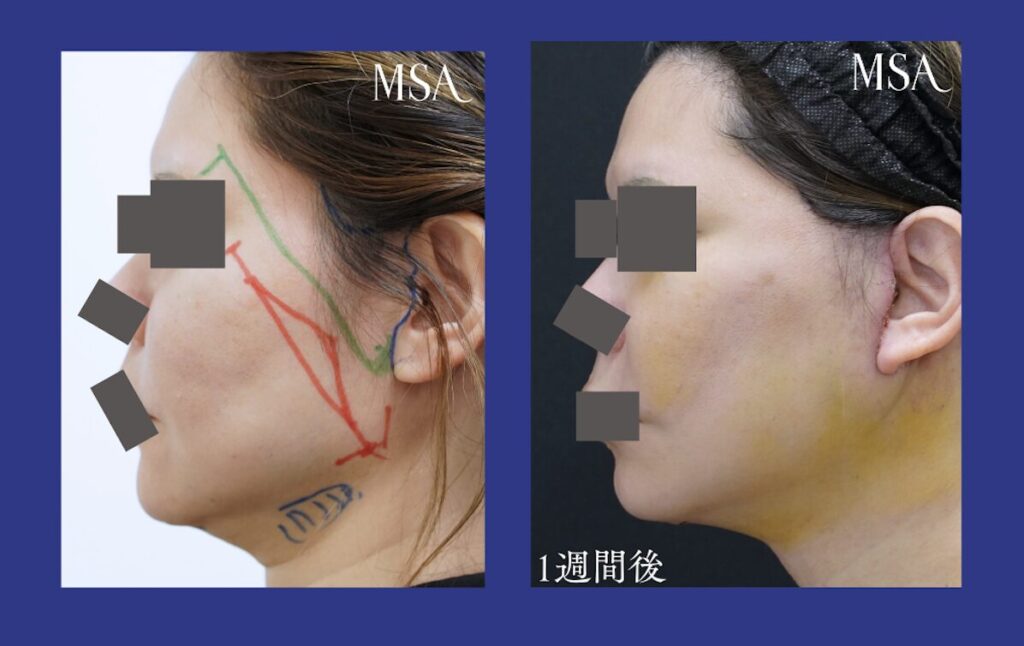
Activity and Long-Term Recovery: After about 2-3 weeks, you can usually resume light exercise and most of your normal routine (always follow your surgeon’s specific advice on this). Strenuous workouts or heavy lifting are often limited for about 4-6 weeks to ensure everything heals optimally. As swelling continues to go down, your results will refine. By 4-6 weeks post-op, you’ll have a very good idea of your rejuvenated look, and it should appear very natural. The incisions will start to mature; any redness will fade over a few months. Because the incisions were placed along natural creases (around the ear and hairline) and not under tension, they typically heal to be quite discreet. Many patients find that by 3 months out, they’re camera-ready even with hair pulled back.
Results and Outlook: One of the most rewarding aspects of the extended deep plane facelift is seeing a truly rejuvenated yet authentic reflection in the mirror. Your face will still look like “you” – just more youthful and refreshed. Friends may comment that you look well-rested or that you’ve lost weight, without guessing you’ve had surgery (unless you choose to tell them). The enhancements are often described as “subtle but significant.” You’ll likely notice your cheekbones are more lifted, restoring that heart-shaped facial curve of youth. The jawline will be crisper, jowls gone, and the neck smoother and firmer. Importantly, these results are long-lasting. While no procedure can stop the aging process, the clock has been set back dramatically. Patients commonly enjoy 10-15 years of improvement from a deep plane facelift technique. Many surgeons have observed that even as you continue to age, you age from a younger baseline – meaning you will likely always look younger than you would have without the lift. The longevity is a big advantage; you can think of it as gaining a decade of youthful looks, liberating you from the cycle of constant minor treatments.
During your follow-ups, your surgeon will monitor your healing and let you know when you can resume all activities (usually by 4-6 weeks most restrictions are lifted). They will also guide you on scar care (such as massage or silicone gel, though with minimal tension, scars often do well). Most patients are extremely satisfied with their decision to undergo an extended deep plane facelift because it delivers a high level of improvement with a single procedure. Knowing that you have invested in the most advanced facelift method available can give you confidence that you’ve achieved the best possible rejuvenation for your face.
Emotional Well-being: It’s normal to go through an emotional adjustment after cosmetic surgery. In the first week, when swelling and bruises are present, you might feel a bit low or anxious – this is common and temporary. As the swelling fades, your excitement will build. By a few weeks out, when you see the lovely changes, any initial worries are usually replaced by happiness and boosted self-confidence. The goal of the extended deep plane facelift is not just to make you look better, but to make you feel better about how you look. Many women over 40 report that their reflection finally matches the youthful energy they still feel inside.
Advanced yet Safe Technique: The extended deep plane facelift is a more complex operation than a basic facelift, and it should be performed by surgeons with specialized training in this method. In experienced hands, it is very safe. The risk of complications like nerve injury is low (temporary weakness in certain facial muscles can occur but is uncommon and typically resolves if it does). Leading surgeons have refined this technique to maximize benefits and minimize risks – for instance, modifications in the extended deep plane method actually reduced swelling around the eyes compared to older deep plane methods by preserving certain muscles. Always follow your surgeon’s instructions closely, as that will also ensure the safest recovery. If you have any questions or concerns during healing, you should reach out to your surgical team – they are there to support you.
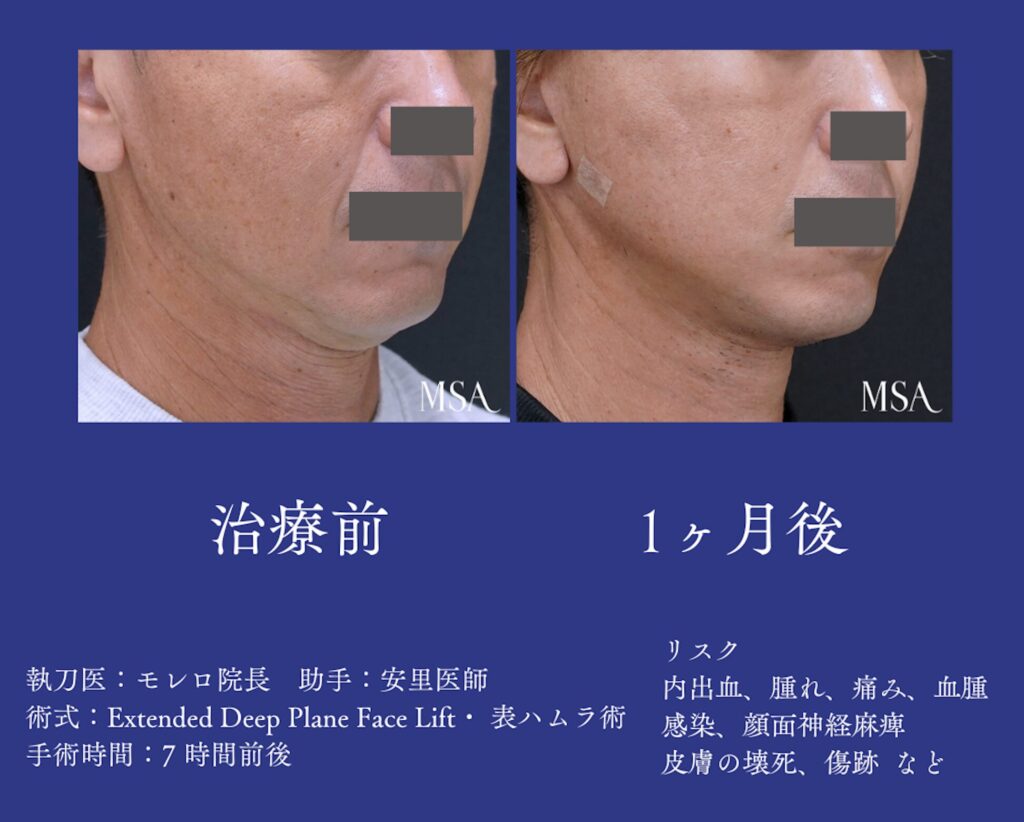
In conclusion, the extended deep plane facelift represents a blend of art and advanced science in facial rejuvenation. It offers women (and men) in their 40s and beyond a way to turn back the clock in a natural-looking manner, addressing the deeper causes of aging rather than just the surface. With its emphasis on preserving your identity – “enhance, never erase,” as our clinic’s philosophy says – this technique can achieve a refreshed appearance that feels true to who you are. If you are considering a facelift and want the latest, most effective approach for long-term results, the extended deep plane facelift may be the ideal choice. By choosing a skilled surgeon and following the proper care, you can look forward to firm cheeks, a sculpted jawline, and a graceful neck – in short, a rejuvenated face that still moves and smiles just as it always did, without the tell-tale signs of surgery. And perhaps the best part: you can enjoy those beautiful results for many years, aging gracefully and confidently with the help of this remarkable technique.
reservation診察予約
お気軽にお問い合わせください。
受付時間:9:00~18:00
夜間診療あり(指定した金曜日の20:00~22:00)
 LINE予約
accessアクセス
MSA美容外科
〒900-0006
沖縄県那覇市おもろまち4-9-10ブギービル5階
- 電話番号:
- 098-867-3311
- 診療科目:
- 美容皮膚科・美容外科・皮膚科・形成外科
- アクセス:
- 那覇メインプレイスから徒歩5分
- 休診日:
- 不定休
- 駐車場:
- 駐車場について
 WEB予約
WEB予約
 電話予約
電話予約