
category
- ALL
- Bilingual Doctor
- Breast augmentation
- Deep Plane ミニリフト
- Extended Deep Plane Facelift
- HIFU
- Medical Hair Removal
- Rejuran
- Rhinoplasty
- Uncategorized
- お知らせ
- カウンセリング
- くま治療
- しみ
- スキンボトックス
- たるみ
- ヒアルロン酸
- フェイスリフト
- ボトックス
- ボルニューマ
- メンズ美容医療
- わきボトックス
- わき汗
- 乳輪の色素改善
- 他院修正
- 医療アートメイク
- 医療脱毛
- 学会活動
- 新メニュー
- 毛穴
- 無断キャンセル
- 症例画像
- 眼瞼下垂
- 立体脂肪注入
- 美容
- 美容外科学会(JSAPS)
- 肌メンテ
- 肌育
- 肌質改善
- 肝斑
- 脂肪注入
- 自分らしさを消さない
- 裏ハムラ
- 論文
- 豊胸
- 針脱毛
- 骨切り
What Does “English-Friendly” Really Mean at a Plastic Surgery Clinic?
監修医師

MSA美容外科 院長モレロ オースティン誠
1989年、アメリカ生まれ。10歳より沖縄で育つ。日本とアメリカ、双方の文化や価値観に触れてきた経験を生かし、患者様一人ひとりが持つ異なる美意識や希望を尊重した診療を大切にしています。日本語・英語の両方で診療を行い、国内外の知見を取り入れながら、自然で長期的な美しさを目指した美容医療を提供しています。大手美容外科にて約8年間、美容外科・美容皮膚科診療に携わり、2024年にMSA美容外科を開院。
略歴
2018〜2024年 大手美容外科沖縄院 院長
2024年 MSA美容外科 開院
資格・所属学会
日本美容外科学会(JSAS)認定専門医
日本美容外科学会(JSAS)正会員
日本美容外科学会(JSAPS)関連会員
The Rhinoplasty Society 海外会員
American Academy of Cosmetic Surgery(AACS)正会員
日本美容皮膚科学会 正会員
日本美容外科医師会 正会員
Many clinics in Japan describe themselves as “English-friendly.” But what does that actually mean?
It may mean that translated documents are available.
It may mean that an English-speaking staff member can help with appointments or basic instructions.
In some cases, communication with the doctor may still depend on an interpreter, simplified English, or a translation application.
These services can be helpful. However, plastic surgery requires more than basic communication.
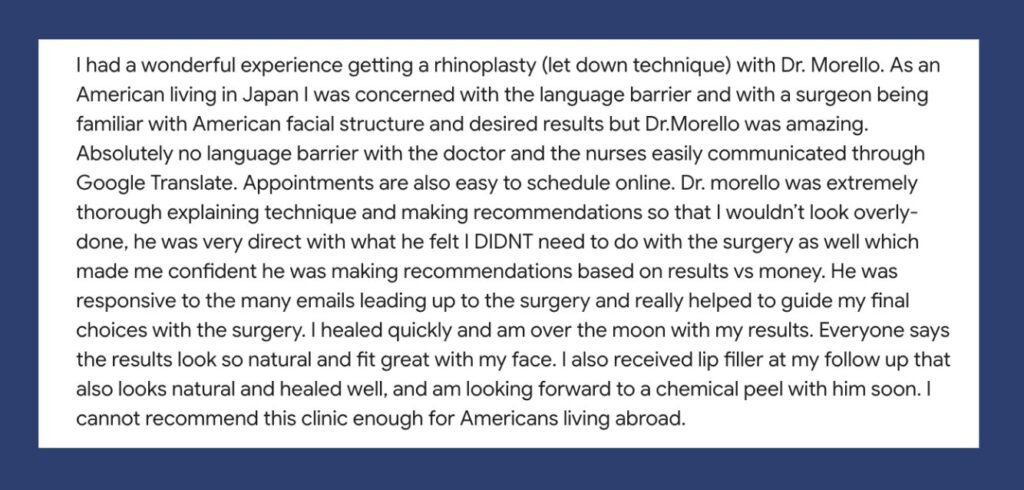
At Morello Surgical Arts, or MSA, English-speaking patients communicate directly with the surgeon who examines them, plans their treatment, performs their procedure, and manages their postoperative care.
Dr. Austin Morello is American. Born in the United States and raised in Okinawa from the age of ten, he speaks both English and Japanese and provides consultations, surgical planning, informed consent, treatment, and follow-up directly in either language.
English is not simply an additional service at MSA.
It is one of the languages in which medical care is provided.
We may not be “English Friendly”, but we are genuinely bilingual.
Your Surgeon Speaks English
Plastic surgery involves detailed and highly personal communication.
Patients need to explain not only what they would like to change, but also what they want to preserve, how noticeable they want the result to be, and what feels natural to them.
Words such as “smaller,” “refined,” “lifted,” or “natural” can mean very different things to different people. A result that seems subtle to one patient may feel dramatic to another. These differences are not minor. They can influence the entire treatment plan.
At MSA, these conversations take place directly between the patient and Dr. Morello in English or Japanese. There is no need for a third person to interpret aesthetic preferences or simplify a complex surgical explanation.
The surgeon can ask further questions, examine the patient, explain the available options, and confirm that both sides understand the same goal.
The person explaining the operation is also the person performing it.
This is something very rare not only in Okinawa, but in Japan.
Understanding Culture, Nuance, and Everyday English
Communication is shaped not only by language, but also by culture.
Patients do not always describe their concerns using formal medical terms. They may use slang, idioms, humor, indirect expressions, or culturally specific phrases to explain how they feel about their appearance.
Dr. Morello understands both natural, everyday English and the cultural context behind it. He can recognize differences in tone, implied meaning, humor, hesitation, and personal boundaries—not simply the words being spoken.
This makes it easier for patients to speak naturally rather than carefully simplifying everything into language that might be easier to translate. It also helps the surgeon understand what the patient is truly asking for, including concerns that may be difficult to express directly.
In aesthetic surgery, these nuances matter. Understanding the intention behind a patient’s words is often just as important as understanding the words themselves.
Advanced Aesthetic Plastic Surgery in Okinawa
MSA provides care ranging from nonsurgical aesthetic treatments to advanced aesthetic plastic surgery.
Our surgical practice includes rhinoplasty, revision rhinoplasty, extended deep plane facelift, lower eyelid and midface procedures, breast surgery, and other operations requiring detailed anatomical planning.
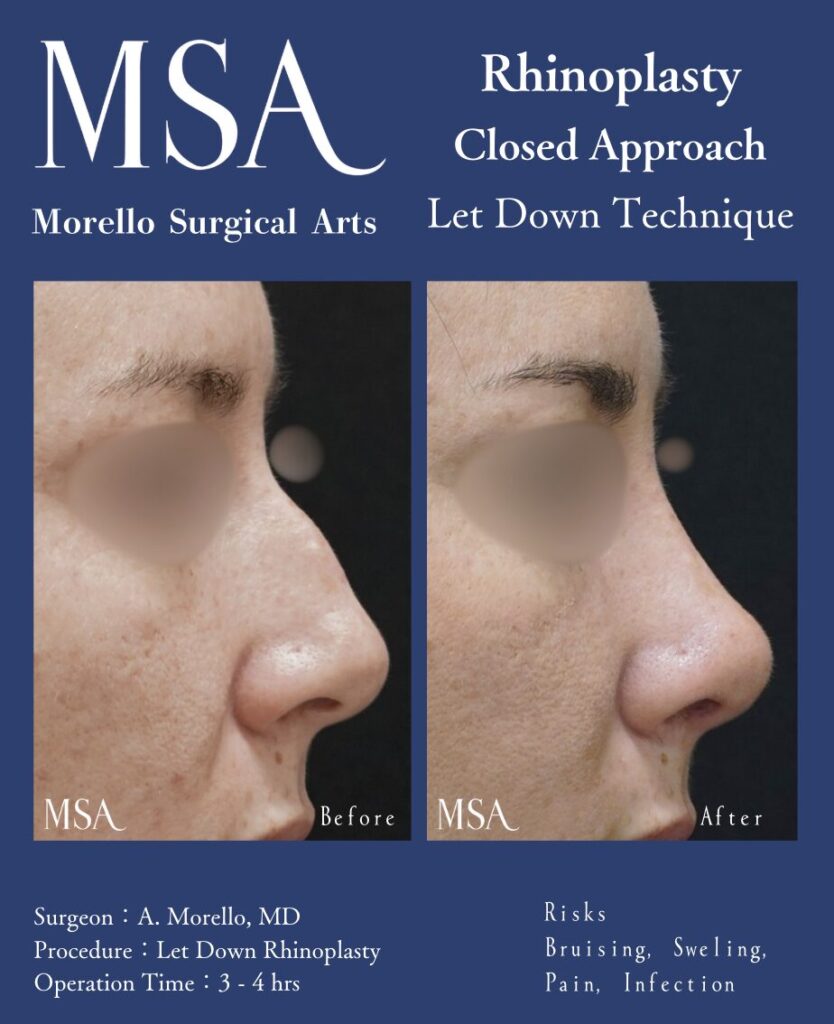
In rhinoplasty, treatment may include closed techniques, nasal tip refinement, septal procedures, cartilage grafting, and preservation techniques such as push-down or let-down rhinoplasty.
The aim is not simply to make every nose higher, narrower, or sharper.
The nose must be considered in relation to the forehead, eyes, lips, chin, facial width, ethnic background, and the patient’s personal goals.
In facial rejuvenation, treatment options range from injectables and energy-based devices to extended deep plane facelift surgery.
For appropriate patients, an extended deep plane facelift addresses the deeper facial tissues rather than relying mainly on tension placed on the skin. The purpose is to reposition descended tissue in a more anatomically appropriate way and create a natural, durable improvement.
Not every patient needs surgery. At the same time, nonsurgical treatments cannot correct every degree of tissue laxity.
A surgeon-led clinic should be able to explain both sides honestly.
So, what does the English Speaking patient need?
At MSA, we do not maintain an English-language page simply to direct international patients toward a set of predesigned, fast-food-style cosmetic procedures.
At MSA, we don’t have a simple translated consent form, because each pateant’s treatment differs, and so does the consent form.
At MSA, we do not offer occasional assistance from an English-speaking staff member, because the essential conversation takes place directly with the surgeon.
This means that patients can explain their goals directly to the person who will examine them, design their treatment, perform their surgery, and manage their recovery.
This means that surgical planning, risks, limitations, anesthesia, downtime, and postoperative concerns can be discussed without relying entirely on an interpreter.
This means you will be heard and understood directly by your surgeon—as you should be.
This combination allows MSA to offer something distinct:
Direct medical care in English and Japanese, surgeon-led treatment planning, and advanced aesthetic plastic surgery in Okinawa.
That is what every patient deserves.
By Appointment Only
reservation診察予約
お気軽にお問い合わせください。
受付時間:9:00~18:00
夜間診療あり(指定した金曜日の20:00~22:00)
 LINE予約
accessアクセス
MSA美容外科
〒900-0006
沖縄県那覇市おもろまち4-9-10ブギービル5階
- 電話番号:
- 098-867-3311
- 診療科目:
- 美容皮膚科・美容外科・皮膚科・形成外科
- アクセス:
- 那覇メインプレイスから徒歩5分
- 休診日:
- 不定休
- 駐車場:
- 駐車場について
 WEB予約
WEB予約
 電話予約
電話予約